Now on Google Maps!


View Adventures in SEA/Nepal in a larger map

Wednesday, July 8, 2009

Uncle Tan's Rain Forest Camping

We went camping in the tropical rain forest located along the Kinabatangan River in Sabah, Borneo with a tour company called Uncle Tan's. Unfortunately, most of the rain forest has been destroyed and replaced with plantations, so there are only small pockets of forest left. These pockets are connected by thin corridors along the river. This forces the wildlife to live close to the river, making it relatively easy to spot.

We camped for 3 days and 2 nights. The first night we went on a night ride down the river. The guide had a big torch light that he used to light up the animals so we could see them. It was really impressive how well the guide moving at 20 miles per hour and was able to spot animals as far as 200 meters away. Even when they were hiding behind the bushes and trees. That night we saw long-tailed macaques (a type of monkey), a crowned owl, stork billed king fishers (which are really cool-looking birds that are bright and colorful with huge heads), a creepy crocodile, civets (a small mammal that is part of the cat family), and proboscis monkey (famous for their large noses).

Sleeping in the rain forest is an adventure within itself. We slept in stilted, 3-walled huts with two other couples. The only thing protecting us from the creatures of the jungle was a mosquito net. Leslie and I were quite squeamish that first night as we kept imagining all the different creepy crawlies that could sneak onto our bed while we sleeping. The noises of the forest kept me awake for a while. All night long you hear an orchestra of chirping, squawking, grunting, humming, and clicking. It may even be noisier in the forest at night than during the day!

At 6am the next morning we went for a morning boat ride. Animals are the most active at this time of the day because it is still relatively cool. We saw orangutans, horn bills (birds with big horns on their beaks), egrets, a Brahminy kite, a white-billed fish eagle, and a monitor lizard swimming in the water. But the coolest part of the ride was when we spotted a whole group of river otters frolicking at the edge of the riverbank. They were scurrying along the shore and diving in and out of the water.


Can you spot the simian in this photo?


After breakfast we went on the morning trek. It was hot and muddy, but still really fun! We saw a lot of strange insects including really fat millipedes that rolled into a ball like a rolly poly (they were over an inch wide!), spiders, lots of colorful butterflies and moths, and other critters that we didn't know the name of. We also spotted a pygmy squirrel, which is the size of a small mouse. It was really cute as it bounced around in the tree branches. My favorite animal of the hike was the tractor millipede. It is about three inches long and smells like marzipan when you scratch its back! I wonder if it tastes like marzipan...Apparently, the millipede secretes the marzipan odor for protection because most animals don't like the smell. Oh yeah, there were also small glow-in-the-dark mushrooms growing along the side of the trail every so often.

We had some down time in the afternoon because there are not too many animals out during the hottest part of the day. Leslie and I spent part of the time relaxing in hammocks, looking up at the canopy. It is amazing all the life you can see when you lie still. All around us were insects, lizards (with a really bright yellow neck), and squirrels. It was so relaxing we both ended up falling asleep.

In the late afternoon it started raining (as can be expected in a rain forest), so we rushed into the boats for our evening boat ride. As Leslie and I huddled under our umbrella, we watched proboscis monkeys and macaques jump through the trees and chase each other along the river bank. We also spotted silver leaf monkeys and all the other birds mentioned before. By far the coolest thing we saw that ride were the hundreds of flying foxes (a type of large bat with a face that looks like a fox) soaring through the sky.

We made it back just as it started pouring and got to enjoy a nice warm dinner.All the meals at Uncle Tan's are really good. It was buffet style with seven to ten different stir fries over white rice. And they go heavy on the veggies which was really nice. The meal always ends with cut up watermelon, which is a perfect dessert in the hot, humid tropics. As you can imagine, Leslie took full advantage of this buffet! One British dude even commented on the massive amounts of food Leslie ate, saying, "For a small guy, Leslie can sure eat a lot!".

Our last outing was the night hike. It was really fun because we all had flashlights, so we could all participate in finding wildlife. We saw 2 different types of frogs, another kind of civet (whose eyes flashed red), the poisonous wolf spider (which is about 5 inches big and has a really cool pattern on its back), and, of course, a lot of other insects. Our guide also found a sleeping ashy-tailor bird. It was an adorable small fluff ball that cannot see in the dark, so we were able to get as close to it as we wanted. Right at the end of the hike, Leslie spotted a huge (8 inches long!) centipede. It was feasting on a worm when Leslie first saw it, but quickly ran away when we shined our lights on it to get a closer look. Our guide told us that centipedes are poisonous and can leave some nasty bites. It took a lot of will power to crawl into bed that night!


Overall our rain forest camping experience was really cool and exciting. But we were definitely grateful at the end of three days when we got back to the luxuries and comforts of civilization.

Monday, July 6, 2009

Sepilok Orangutan Rehabilitation Center

What a flurry of updates! Don't miss the Kinabulu post just below!

Before we left for our Rainforest camping experience we stopped by the nearby Sepilok Orangutan Rehabilitation Center, one of 3 such centers in the world. The goal is to slowly rehabilitate injured or sick orangutans and reintroduce them to the wild.

The center is located at the edge of the rain forest, and a wooden boardwalk extends out to their feeding time platform. This gives visitors a chance to see orangutans up close. During the actual feeding time, a worker sits on a platform 10 m away with a bucket of bananas and hands them over to the orangutans that come. Macaques scurry around trying to snatch half eaten bananas. The better thieves make off with a whole bunch. Two orangutans showed up for the feeding, although other travelers have told us that up to 5 have shown up at a time.

We stuck around on the boardwalk after most of the tourist left and watched the macaques claiming the scraps and scampering around. As we began to leave, an orangutan appeared on the walkway and started walking towards us with a gentle, lumbering grace. It passed in front of Rashmi by about 1 ft!


Afterwards we wanted to head out to a short 2 km jungle trail. As we walked along the boardwalk, we saw an approaching band of macaques chasing 2 panicked tourist towards us. We faced off the monkeys a little bit and they quietly would pass us or sit down and have a grooming session. As I filmed a grooming couple a passing macaque jumped on my backpack and held on!


The Troublemakers


He seemed to be clinging on in curiosity and not aggression although I still did not want a monkey on my back. I swung around a few times and was able to shake him off, but after that we quickly made our way to the trail. The trail itself was muddy and overgrown. As we pushed through we saw small black worms perched on leaves reaching and extending towards us. It was our first leech encounter!


We carefully picked our way through and saw numerous butterflies and crawling insects. A group in front of us pointed out a walking stick insect on the ground! We were very excited to see it as it can be very hard to spot.


As we hiked back I realized my toe was bleeding, but I hasn't felt it get cut! It just kept bleeding and bleeding and I realized a leech must have bitten me and put in some anticoagulant. When we returned to the center, I sat down and did a leech check and found one squirming in my belt buckle! I'm glad the leech didn't bite me anywhere in that region! Overall we definitely got had a fun experience and got up close with some creatures we wouldn't have otherwise.

Kinabulu National Park

We arrived on June 24th via minibus to Kinabulu National Park. The 2 hr ride up into the mountains was in a packed van with no AC. Along the way way made some detours such as picking up store room supplies from a local KFC!

Kinabulu National Park is a World Heritage site and contains the highest mountain between the Himalayasa and Papua New Guinea. At the center sits Mt. Kinabulu (4095 m) which towers over the park. Instead of a sharp distinct peak, the top has a number of peaks and bulges similar to beaten meringue. Many visitors come to the park for the grueling 2 day hike up to the top for a glorious or foggy sunrise. Fog is the more likely outcome as most days the mountain top was covered in fog. One tourist was even shocked to see the mountain after 2 days of staying nearby! We decided to explore the trails of the park on our own instead of paying the permit, guide, and mountain hostel fees just to hike up to the top in the dark.


A caterpillar? It would drop down on a strand of silk/web


Most of the trails were part of a forest that gets a large amount of moisture from the fog clous that constantly rolls through. We didn't see too many animals, although we spotted a woodpecker in action. We did see many colorful butterflies which Kinabulu is known for.

Quick pop quiz! What is the scientific name of this butterfly? It was quite large, with a wingspan of about 5 inches


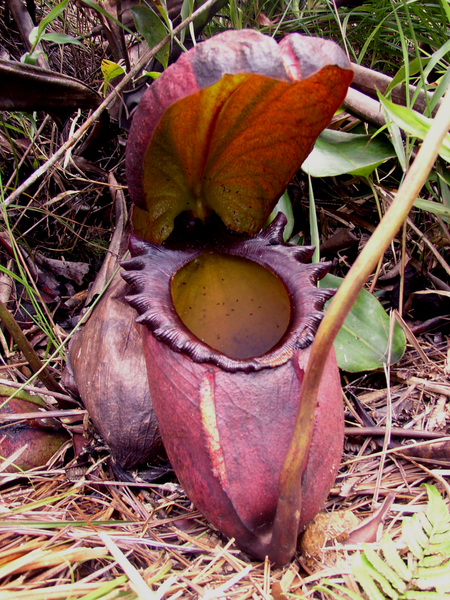
The park also has a large amount of endemic species. In particular are 3 different species of carnivorous pitcher plants. Since we didn't shoot for the summit, we missed out on seeing the other flora that occupy the higher alpine ecosystems.

A pitcher plant endemic to the area. Source: Wikipedia


Overall, the park was great, with good trail markers and facilities. Prices to stay in hostels have been enormously inflated as they prepare themselves for a more international crowd, however lodging just 800 m from the entrance is reasonable. The park also contains a small botanical garden that gathered the carious flowering and more interesting plants, although, it must not have been in season when we went to see it.

Monday, June 22, 2009

Kota Kinabalu

Kota Kinabalu has been my favorite part of the trip so far! The first (June 20) evening in KK, we visited the bustling night market which sets up every evening near the waterfront. It was fun to see all the edible goods that they had available: fresh fruits and veggies, nasi campur (Malaysian food buffet), deep fried snacks, and chunky, colorful drinks. Of overwhelming abundance was their seafood. First we walked through a market of dried seafood, which greeted us with a really pungent fishy aroma. Then we passed through the fresh seafood market. This was really cool - I have never seen that much seafood in one place at one time. There were over 50 vendors selling fish of all kinds, squid, octopus, crustacians, and even rays. We finally ended up in the cooked seafood market, where locals and non-locals were enjoying their dinner of fresh seafood that was grilled right when ordered. Leslie's mouth started watering, so we had stop and sample some of it. We first shared a skewer of grilled shrimp. It had a really satisfying aftertaste. Leslie was really craving squid, so we ended up ordering four squids. Once put on my plate, I was too grossed out by the tentacles and the insides, and was not able to eat any of it. So poor Leslie had to finish all four squid...at least he was able to satisfy his craving.


Yesterday (June 21) we went to the Sabah Museum, a museum which focuses on the the cultural heritage of the different indigenous people of the state of Sabah, Malaysia. It was quite a journey to get there, as we chose to walk the 3 miles during the hottest part of the day (which is very hot when you are in Malaysia). It was not the smartest move, but the museum was definitely worth it. They had lots of cool artifacts, tools, and traditional clothing of the various cultures from different times in history. They also had an interesting display on the harvesting of swallow nests for the Chinese delicacy, bird's nest soup. Although it can be very harmful ecologically, it plays an important role in the local economy. But by far my favorite part of the museum was the heritage village, where they had life sized replicas of all the different traditional homes built by the indigenous people. It is crazy that they can build a whole house just out of bamboo and straw! Inside the houses were some artifacts used in the natives' everyday lives, such as baskets, musical insturments, and weapons. To get to the heritage village we had to venture over a rickety suspended bridge...it was pretty exciting.


The rickety suspension bridge!


Today was actually my favorite day of the trip so far. We took a boat out to the nearby island, Pulau Manukan. In the morning we snorkelled in the the bay of the island. It was really cool because most tourists did not know that there was a reef a little further out in the water and they stayed very close to shore (where they attracted fish by feeding them, which really annoyed me!). But Leslie and I found the reef and spent an hour snorkelling around by ourselves. We saw some new fish species, hundreds of sea cucumbers, and spiny coral. But the most exciting part was the jellyfish. At first I thought that I kept swimming into small bits of plastic bags, but then Leslie realized that they were jellyfish. Lots of little jellyfish were floating all around us. Some were even luminescent. At first I was scared of getting stung, but then Leslie started touching them and discovered that their sting was painless. I was pretty creeped out, but tried overcome my fear by also touching them. It was weird because they looked so weightless, but then when I felt them they seemed quite heavy and jello-like.

In the afternoon we went on a walk through some of the island's rainforest. The path led us to a small trail which led us to a private beach! To get there, we had to cross some tide pools. The tide pools had really funny jumping creatures. The looked like small fish, but sun-bathed like lizards, and jumped about in the water like frogs...I don't know what kind of animals they were. There were also some really cute hermit crabs that scuttled around with shells on there backs. They were really fun to watch because they each had a unique shell and a unique personality. Some were very shy and others were very jittery and would not sit still. The beach was beautiful and very serene. Leslie and I lazed away the rest of the afternoon there. In the evening we treated ourselves to a somewhat pricy, but very delicious Italian dinner. I think Leslie and I are finally learning how to live it up!

Saturday, June 20, 2009

Kuala Lumpur

We arrived in Kuala Lumpur, Malaysia just a few days ago. In the city we stayed in the Chinatown area. It was quite striking to see the difference of Malaysia compared to Indonesia. The entire area seems much more diverse, with Chinese shops selling food next to an Indian sari store. They also have most signs translated to English and sometimes even Chinese.

Upon arrival we were famished so we wandered over to the neighboring Little India and found a chapatti house. It was delicious to eat okra and chickpeas with freshly made wheat chapattis, especially with my hand!

The next day we also checked out a well known Dosa restaurant. The reception we got there was not as friendly, but the Dosa which I had never had were quite tasty. Dosas seem to be a pancake made of rice flour within which you can put different sauces and vegetables. I ordered a special one that had ghee spread on the outside which gave it a deliciously crispy butter flavour as well.

There is also a bustling night market area in the Chinatown district, one alley over from our hotel. I've got to use my Chinese a bit to order different dishes and they seem to speak at least 4 languages: Mandarin, Cantonese, Bahasa Malaysia, and English. The guy I asked might have even said he spoke Hindi but I didn't test him on it. Vendors setup little stalls selling watches, shoes, fruit, noodle dishes, baked goods, meat etc. There is a noodle vendor literally at our hotel doorstep!


We checked out the Lake Garden area nearby, which has a number of national museums and monuments. It was a very pleasant walk over and there are a number of great examples of Islamic architecture.


We went to the KL Bird Park which is touted as "The world's largest free-flight walk-in aviary." Inside an enormous netted off complex was a rainforest that birds just flew around in, as well as cages displaying some particularly interesting tropical birds. We saw many different species of colorful birds such as hornbills, peacocks, and toucans.

The Incubation Room

Just across the street from the bird park was the Orchid and Hibiscus garden, which was very well kept. There were a number of beatuiful displays of flowers, which I know that my mom and aunt would like. The afternoon rain though had left the entire city very stuffy and humid, and we were soon drenched in sweat. I never thought I would appreciate AC as much as I have in Malaysia.

Wednesday, June 17, 2009

I'm Lovina it!

We arrived in the coastal town of Lovina on June 11th. Lovina is a tourist town on the northern shore of Bali known for its early morning dolphin sighting tours. A majestic dolphin statue even marks the towns fame. Apparently tourist season is low right now and we've not seen many tourists. Establishments are even giving low season discounts.


Other than dolphin watching, Lovina is a popular launching point for diving to the nearby dive sites of Menjengen Island, Tulamben, and Amed. Unfortunately, just after we arrived in town, Rashmi came down with a mild case of food poisoning! Guess we have to be even more careful.

Lovina itself is a black volcanic sand beach. The water has no breaks and visibility is not good at all. In other words, not too fun to swim around. All along the shore hawkers chase tourists around with offers of trinkets, massages, and fruit. We finally fulfilled a craving of ours to eat fresh coconut. First the fruit lady poked a whole in it so we could drink the juice within. Then, with a simple metal tool she gave the coconut three sharp thwacks and split in in half. She then pried out all the fruit within with a few more blows. We didn't realize how much coconut flesh it would yield though and were soon coconutted out. Instead of wasting the remaining fruit though, we offered the pieces to any hawkers that approached us. Some would accept and we'd have a pleasant conversation, and others would beat a hasty retreat after having the tables turned on them.

On a rest day, we decided to head out to the only Buddhist temple on the predominantly Hindu island of Bali. It is located about 10 km away from Lovina by motorbike. The only problem was that neither of us knew how to drive one! Motorbikes are the main form of personal transportation in Indonesia, and especially Bali, where you can drive across the whole island in a day. Locals piled them high with chickens, children, and anything they happen to be selling. Other travelers had recommended motorbiking as a way to get around. After seeing one too many 7 year-olds whiz by on a manual motorbike, we decided to try it out. Obviously we would try it out very slowly, and if we felt more comfortable, head out to the monastery.

It really wasn't too hard to get used to motorbiking, except driving on the left side definitely takes some getting used to. As Indonesians are used to cars and bikes going at all speeds on the roads, they are actually quite careful drivers, and the slow speeds help avoid accidents on the chaotic streets. After an hour of doing laps and curlicues in the village we headed out for the monastery.


The Brahma Viahara Ashrama temple is set up in the hills overlooking a quiet village. Meditators gather in rooms and sit or pace very slowly. It is as if they are trying to make their presence unknown at all by being completely silent. At the top of the monastery was an impressive structure with large stupas similar to Borobodur. Lotus ponds and flowering plants also added to the tranquility of the temple.


We've been relaxing in the late afternoon by taking advantage of the happy hour of 30 cents for mixed fruit juices. The bar is set by the beach with a great view of the setting sun and a volleyball court where locals play serious and engrossing game.

Our last 2 days in Lovina we arranged to go diving at two different sites. Tulamben, where the Liberty shipwreck, is and Menjengan Island. We had dived at the Liberty shipwreck before as part of our first open water dive, but this time we got to go deeper and the guide showed us cool features of the ship. He took us on some exciting swim-throughs as well where we got to swim through some of the wider parts of the ship. We were a little concerned about the safety of this, but the professionalism and competency of the guide made us comfortable following him, and i definitely thought it was worth swimming up and through the ship. We also saw some interesting creatures such as a ghostpipe fish. Rashmi got pretty cold this first day as the water was cooler and the wetsuit she had didn't fit very well. We vowed to try and get a better fitting suit so she could enjoy the next day of diving on Menjengan.

We took a boat out across the calm emerald bay to the island of Menjengan, which is known for it's Coral gardens and wall dives. The coral gardens were very colorful and varied and I got very excited about spotting some sea cucumbers. We even got to hold one that was larger than a loaf of bread! These were also our longest dives yet, staying underwater for 60 minutes on our longest dive.

Yesterday we took a bus back down to Kuta, where we spend just a day here and then fly out to Kuala Lumpur, Malaysia! We did some boogie boarding this morning, which was my first time. It was a blast and the waves here are excellent. My favorite vendor is the man who walks around trying to sell a bow and a quiver of arrows to tourists. I'm not quite sure what the market for that is.

Tuesday, June 16, 2009

Gunung Batur

Gunung Batur is a volcano located in central Bali. It is set in a crater that was created from a series of eruptions, the most recent occurring in 2000. The crater also holds Bali's largest lake, Danau Batur. We took a bemo, the local minibus, from Ubud to the crater's rim on the morning of June 10th. From there we were planning on walking the 4km down into the valley of the crater, but we were able to catch a free ride on Made's (the guy who worked for the hostel we would be staying at) motorcycle.

That day we took a walk through some of the villages that are spread out along the circumference of the lake. It was a very peaceful walk because we were not in a touristed area and we were finally able to see what life was like in a village not dependent on the tourist industry. Their main source of livelihood is farming. We saw cabbage, corn, tomatoes, onions, and chili peppers growing. It was nice to interact with Balinese natives knowing that they were not looking to solicit us for anything. Most were friendly - they smiled, said hi, and allowed us to take their picture. Our walk was cut short by ominous rain clouds looming in the sky, and we were able top seek shelter in a warung just as the afternoon rain started coming down strong.

Kids flying a kite in the local village


The next morning we woke up at 3:30 am to summit Gunung Batur in time to see the sunrise. We had organized the hike with guide because we didn't know were and didn't think it was a good idea to look for them in the dark. We later realized that it would actually not be too difficult to do it on our own because there were many other tourists also making their way up the mountain at that time.

The sunrise was spectacular! At first the guide wanted to take us to a lower part of the mountain where a warung was set up so that the tourists could buy coffee and tea as they watched the sunrise. But I was able to convince him to take us to the highest part of the mountain, where their were no other tourists and Leslie and I could enjoy the sunrise on our own. We also had the best view with the crater, hardened lava flow, and sparkling lake below us. Most of the time we were surrounded by clouds and mist, but then, every couple of minutes, the clouds would clear and the view of the valley would open up. We also saw the Agung, the highest mountain in Bali, in the distance, framed with clouds.


At the sunrise summit!

After the sunrise we hiked around the area. It was really neat seeing the way the lava had carved out the valley, all the life that was able to thrive on an active volcano, and the steam pockets that dotted the mountain slopes. It was partially ruined, however, by the guides' inability to communicate properly and his lack of professionalism. For example, we stopped by a cave on our way down. Leslie and I asked if we could go inside the cave. The guide tried to make up some excuse by saying we couldn't because his flashlight didn't work. But Leslie had his headlamp, so he reluctantly showed us inside. Once we had gone in about 10 meters, the guide told us the real reason that he didn't want to take us in. He said that it was holy cave where people meditate and bring offerings. Had he told us this before, we would not have asked him to bring us in. On our way out, another guide started yelling at Leslie and me for going in. He also yelled out, trying to scare me when I was on a slippery stone, trying to make me fall. The guide also cut our hike short, implying that if we wanted to complete the trek as had previously been promised, we would have to tip him.

But despite this, Leslie and I were still happy that we had the opportunity to climb Gunung Batur...it was really amazing! One day we want to come back and hike on our own and bike all around the lake.